Request Crushing, Grinding or Particle-Size Preparation
Use this form when you already have a material or when your main requirement is controlled physical preparation. Your request is saved for admin review, and a confirmation is emailed to you.
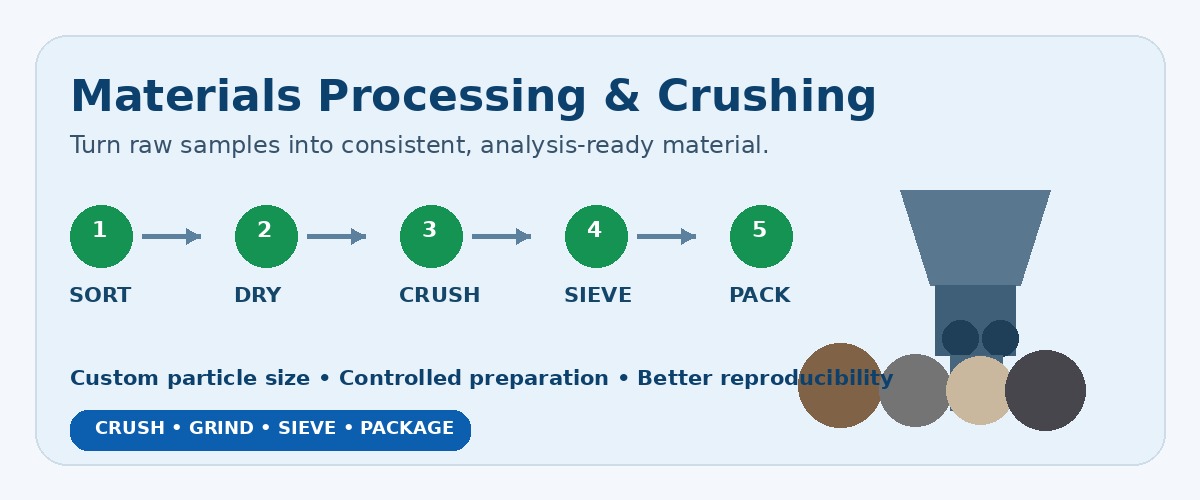
Why particle-size preparation matters in research
Physical sample preparation is often the bridge between a raw material and a reproducible experiment. A rock, shell, polymer, plant waste or biomass sample may arrive as large, irregular pieces, yet the analytical method or formulation may require a much narrower particle-size range. Crushing and grinding reduce the material, while sieving or other classification steps separate particles into a defined fraction. This can improve mixing, extraction, dissolution, reaction rate, packing behaviour and repeatability.
The correct preparation route depends on both the material and the downstream method. Brittle minerals behave differently from flexible polymers. Fibrous plant materials can wrap around some cutters. Hygroscopic powders can absorb moisture after grinding. Heat-sensitive materials may change if milling creates excessive friction. For this reason, the requested size should be considered together with the material identity, starting condition and intended use.
Crushing, grinding, milling and pulverising are not the same
Crushing
Used for primary or secondary size reduction of larger pieces, lumps, rocks, shells and other relatively hard materials before finer preparation.
Grinding / milling
Used to reduce already smaller material into fine particles or powder, subject to the material’s hardness, toughness and equipment compatibility.
Sieving
Separates particles into defined size fractions and is especially useful when a methodology specifies a mesh or micrometre range.
Batch preparation
Allows repeat or replicate samples to be processed separately so researchers can preserve identity, compare batches or reduce cross-mixing.
Materials commonly submitted for preparation
Typical requests may involve dried leaves, seeds, roots, coconut shells, eggshells, agricultural waste, bamboo, sawdust, biomass, PET or other plastics, rocks, laterite, gravel, soil, mineral pieces, food or feed materials and selected industrial solids. Every material must still be reviewed for suitability because some items can damage equipment, present dust or chemical hazards, soften under heat, contain excessive moisture or require special containment.
If you are uncertain whether your material can be processed, upload a photograph and describe the current condition. A photo of the raw sample next to a ruler or familiar object can be especially useful when the starting size is difficult to estimate.
Choosing a target particle size
Researchers should avoid writing only “powder” if the study depends on particle size. Powder can describe a very wide range. Where possible, provide a target such as “below 500 micrometres,” “pass 250 µm sieve,” “retain 125–250 µm,” “2–5 mm granules” or a named mesh size. If the source method specifies a mesh, include both the mesh and any corresponding opening size stated in the method.
Very fine size targets may not be achievable with every material or available processing route. In addition, a sieve result is not the same as a full instrumental particle-size distribution. If your research requires verified D10, D50, D90 or nanoscale particle characterisation, mention that separately so analytical measurement can be considered rather than assuming preparation alone proves the final size distribution.
Drying before grinding
Moisture can strongly influence grinding. Wet plant or biomass materials may smear or agglomerate instead of forming a free-flowing powder. Soils and minerals may also behave differently depending on moisture. Drying can improve size reduction, but the method matters. Air drying is gentler but slower. Oven drying is faster but can affect heat-sensitive compounds. Some biological or chemical samples should not be exposed to elevated temperatures.
Use the form to state any temperature restriction, “no heat” requirement or method-specific instruction. If you do not know, leave a note rather than guessing; the preparation route can be discussed before work begins.
Contamination and cleaning considerations
Grinding surfaces can introduce trace contamination, and residues from a previous material can affect sensitive analysis. This is especially important for elemental studies, trace-metal work, pharmaceutical or food-related projects and projects comparing small differences between samples. Tell us if particular contamination must be avoided or if separate batches must be processed independently.
Cleaning between materials reduces carryover, but no preparation process should be described as contamination-free without considering the equipment, sample and analytical sensitivity. If your method requires a particular milling material, container type or certified clean procedure, include that in the comments so feasibility can be reviewed.
How the processing request works
- Describe the sample: enter the material name, category, starting form and approximate size.
- Specify the quantity: include the amount and unit so equipment capacity and sample recovery can be considered.
- State the target: give the desired particle-size range, sieve or mesh requirement, drying condition and batch arrangement.
- Explain the purpose: downstream use helps determine whether preparation needs stricter handling.
- Submit a photo or link: this is particularly useful for unusual materials.
- Receive follow-up: AnalysisAfrica reviews feasibility, pricing, pickup or delivery requirements and any analytical verification you may need.
Frequently asked questions
Can you crush material that I already have?
Yes. This page is specifically intended for users who already have a material and mainly need physical preparation. Acceptance depends on the material, quantity and processing suitability.
Can I request a precise mesh fraction?
Yes. State the sieve or mesh requirement clearly, including whether the sample should pass, be retained, or be collected between two sieve sizes.
Can you source the sample as well?
Yes, but sourcing requests should start on the Project Materials page. The sourced material can then be routed into processing if required.
Can you make nanoparticles?
Do not assume a nanoscale result from ordinary grinding. If your project requires nanoscale preparation or verified nanoscale size, describe it explicitly so the required method and characterisation can be reviewed.
Will I get an email confirmation?
Yes. The request is stored, the full submission is emailed to [email protected], and a confirmation email with your reference is sent to your supplied email address.
Looking for the material itself?
Return to the main sourcing and supply service for project and research materials.