Request Project Materials
Complete the form with as much detail as possible. Upload a sample image when useful. Your request is saved for the AnalysisAfrica admin team, and a confirmation email is sent to you.
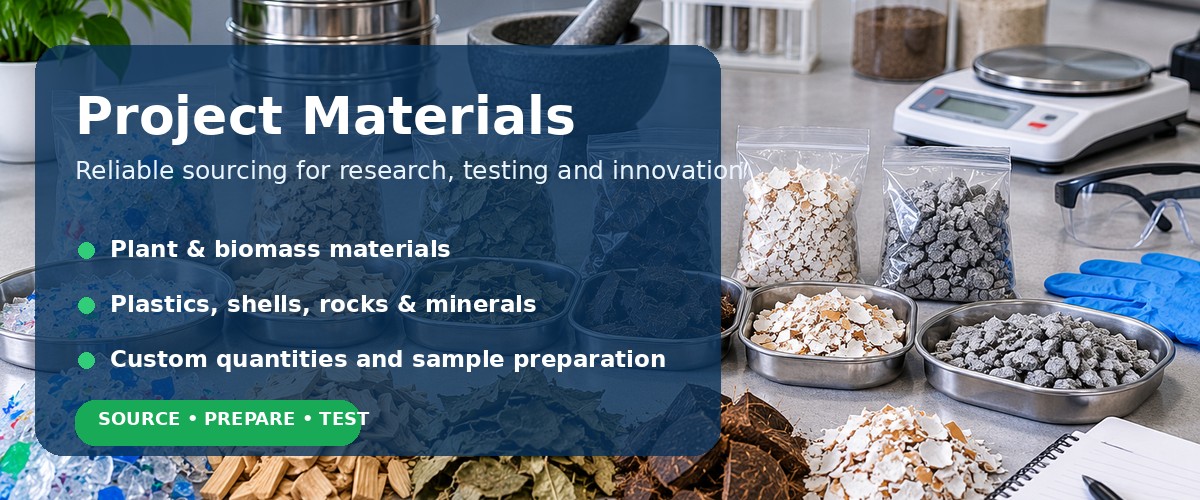
Project Materials for Research, Testing and Product Development
Research often slows down for a simple reason: the required material is difficult to find in the right quantity, form or specification. A student may need coconut shell powder rather than whole shells, a civil engineering researcher may need a defined aggregate size, a chemistry project may require clean plant material for extraction, and an environmental study may depend on a representative wastewater or soil sample. AnalysisAfrica’s Project Materials service is designed to make that practical stage easier by helping researchers describe, source, collect, prepare and move materials into a form suitable for the next stage of their work.
The service is relevant to final-year projects, postgraduate research, laboratory method development, product formulation, pilot studies, engineering trials and industrial investigations. It can cover naturally occurring materials, agricultural residues, manufactured materials and selected laboratory consumables. The important starting point is a clear specification: what the material is, how much is needed, where it should come from, its current form, its intended use and whether it must be dried, cleaned, crushed, ground, sieved, packaged or delivered.
What kinds of project materials can be requested?
Material requests vary greatly by discipline. Plant science and natural-product projects may need leaves, roots, bark, seeds or fruit residues. Energy and environmental projects may need bamboo, sawdust, kitchen waste, animal waste or other biomass. Materials and engineering work may require plastics, granite, limestone, sand, laterite, clay, slates, periwinkle shell, snail shell or metal samples. Microbiology and analytical work may require membranes, agars, culture media or specific chemical reagents. The form therefore allows a broad material category and a precise material name so the team can understand both the general group and the exact request.
Some materials are easy to buy but difficult to prepare consistently. Others are easy to obtain locally but difficult to authenticate, dry, size-reduce or package without contamination. This is why a useful material request should go beyond “I need powder.” State the material, the target particle size or mesh range where known, the quantity, the intended experiment and any purity or source requirement that could affect the project.
Use the dedicated processing page for crushing, milling, grinding, sieving and particle-size preparation requests.
Crushing, grinding and particle-size preparation
Crushing is the controlled reduction of larger material into smaller pieces. Grinding continues that size reduction toward finer particles, while sieving separates material into particle-size ranges. These steps matter because particle size can influence surface area, mixing behaviour, extraction efficiency, reaction rate, adsorption, drying, compaction and the repeatability of laboratory results. A researcher comparing two formulations should not unknowingly compare two very different particle-size distributions.
The AllSchoolabs reference process that inspired this service includes examples such as converting PET bottles into smaller material before crushing, preparing bamboo into powder for biomass work, and processing leaves and seeds into fine powder. It also lists rocks, plastics, periwinkle, snail shell and coconut among materials that may require crushing to a selected size. On AnalysisAfrica, the request form captures both the current form and desired size so the processing route can be discussed before work begins.
A practical material-preparation workflow
State what the material is and why you need it. The same coconut shell, plastic or biomass may require very different preparation for extraction, adsorption, composite production or mechanical testing.
Specify whether a local, industrial, agricultural or commercial source is preferred and whether the project needs grams, kilograms, litres, individual specimens or repeated batches.
Foreign matter, moisture, labels, caps, soil or damaged portions may need removal. Drying conditions should suit the material and research method because excessive heat can alter some samples.
Large or tough materials are usually reduced in stages rather than forcing them directly into fine powder. Progressive size reduction protects equipment and can improve uniformity.
Where a defined range is needed, sieving or another sizing method separates fractions. The prepared material is then packaged to reduce loss, moisture uptake, contamination and mix-ups during transport.
Sourcing materials responsibly
Good sourcing is not just finding the cheapest available item. The source should make sense for the research question. If a project is studying industrial wastewater, a domestic water sample may be irrelevant. If a project compares agricultural wastes, the plant species, location, maturity and processing history may need to be documented. If a study uses aggregates or mineral samples, origin and grade can influence the result. Researchers should therefore keep basic provenance information and avoid silently substituting one material for another.
Availability also matters. Some materials are seasonal, geographically restricted, hazardous to collect, regulated or expensive to transport. For these requests, an early enquiry gives the sourcing team time to confirm whether the material can be supplied lawfully and safely. A photo, supplier page, video or example link can be added to the form when the name alone is ambiguous.
Preparation for plant materials, biomass and agricultural waste
Leaves, seeds, roots, peels, husks, shells and other biomass are common in chemistry, microbiology, environmental science, food science and renewable-energy studies. Typical preparation may include sorting, washing when appropriate, draining, controlled drying, cutting and milling. Researchers should be careful about conditions that could change the compounds being studied. Sun drying, oven drying and air drying are not always interchangeable, and the correct choice should follow the project method rather than convenience alone.
For biogas, adsorption, composite or fuel-related work, particle-size reduction can improve handling and increase accessible surface area. However, the project protocol should define the desired particle size whenever possible. “Fine powder” can mean different things to different laboratories; a numeric target, sieve size or acceptable range is more reproducible.
Plastics, shells, rocks and hard materials
PET, polymer pieces, shells, rocks and similar hard materials often require more mechanical preparation than plant samples. Plastics may need cleaning and separation from caps, labels or mixed polymers. Shells may require washing, drying and staged crushing. Rocks and aggregates may need jaw crushing, milling and sieving. For every hard material, the team must consider equipment compatibility and the possibility of metal wear or cross-contamination when very fine powders are required.
Projects requesting very small particles should also decide how size will be confirmed. A sieve can classify coarser ranges, but finer or nanoscale claims may require analytical particle-size measurement or microscopy. If your project specifically depends on a verified particle-size distribution, write that in the comments field so preparation and testing can be quoted as separate requirements.
Sample quality, contamination and traceability
The usefulness of a material depends on more than appearance. Sample identity, cleanliness, moisture, storage and packaging can influence downstream testing. For example, a biomass sample stored wet may develop microbial growth; a hygroscopic powder may absorb moisture; a soil sample collected with unsuitable tools may acquire contaminants. Researchers should specify whether the material is for routine experimentation, sensitive chemical analysis, microbiological work or another application requiring stricter handling.
Where traceability matters, retain the request reference, material name, source information, date received and preparation details in the project notebook. This makes it easier to explain the method later and to obtain a comparable batch if repeat experiments are needed.
Who can use the Project Materials service?
Students
Final-year and postgraduate researchers who need reliable materials, sample preparation or help turning a written methodology into a practical material specification.
Research laboratories
Teams that need repeat batches, prepared samples, special sourcing, controlled size fractions or materials sent for further analytical testing.
Industry and product developers
Organisations conducting formulation, process, quality, waste-utilisation or proof-of-concept studies with raw and processed materials.
Multidisciplinary projects
Engineering, chemistry, agriculture, environmental science, geology, food science, microbiology and other fields that require physical samples.
How to get a useful quotation quickly
Complete specifications reduce unnecessary back-and-forth. Enter the exact material name, material type, current form, quantity and unit. Add the desired particle size or final form where relevant. State whether you already have the material and only need processing, or whether AnalysisAfrica should source it. Include your institution and department because this gives useful context for the kind of project involved. Add a project title, purpose, deadline and location when available.
If you have a photograph of the required material, upload it. If the material is shown in a publication, supplier page or demonstration video, paste the link. Use the comments field for anything that could change the job: source restrictions, washing instructions, drying temperature, purity, mesh size, packaging, number of separate batches, pickup requirements or whether a certificate or additional analytical test is needed.
Frequently asked questions
Can I request a material even if I do not know the exact size?
Yes. Enter the information you have and describe the intended experiment. The team can ask follow-up questions and help translate a general requirement into a practical specification.
Can I send my own material for crushing or grinding?
Yes. Choose the relevant processing service and state the current form, quantity and target size. Final acceptance depends on the material and equipment suitability.
Can AnalysisAfrica source materials and also prepare them?
Yes. Select “Source + process + deliver” and describe the required source, processing method and final specification.
Do you guarantee a requested micron or nanoscale size?
No size should be guaranteed before reviewing the material and available processing and verification method. The requested size is treated as a target and the achievable specification is confirmed with you.
Will I receive confirmation after submitting?
Yes. The request is stored for admin review, the details are emailed to [email protected], and a confirmation email containing your reference number is sent to the email address you provide.
Start with the material specification
A good project material is one that fits the research question, arrives in sufficient quantity, is prepared consistently and can be described clearly in the methodology. Use the request form above to tell AnalysisAfrica what you need. Whether the task is sourcing leaves, preparing biomass, crushing shells, grinding rocks, processing plastics, arranging wastewater samples or supplying another research material, the request reference gives the team a clear starting point for follow-up, pricing and delivery planning.