Request Sample Calcination
Give us the conditions you need as clearly as possible. If your method specifies a temperature programme, crucible type, heating rate or cooling condition, include it below rather than assuming a standard cycle.
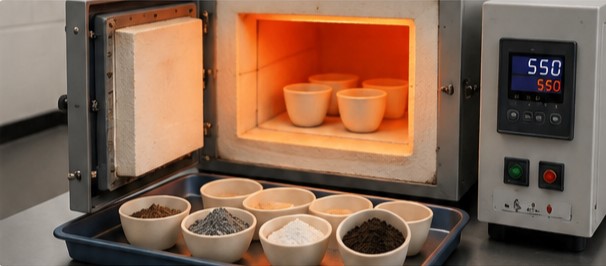
Sample calcination: what the furnace is really doing to your material
There is a point in many laboratory projects where the sample has to meet heat deliberately, not casually. You may be trying to remove organic matter, produce a stable ash, convert a precursor into an oxide, condition a mineral before analysis, or reproduce a published preparation method. That is where a muffle furnace becomes useful. It gives the laboratory a controlled high-temperature chamber in which a sample can be heated according to a defined temperature and time programme.
Still, “put it in the furnace” is not a complete method. Two samples heated to the same final temperature can behave very differently if their moisture content, particle size, crucible, heating rate, mass or holding time differs. A good calcination request therefore begins with the sample itself and the scientific reason for heating it.
What calcination means in practical laboratory work
Calcination is a thermal-treatment step in which a solid is heated, commonly in air or another specified atmosphere, to cause a desired physical or chemical change. Depending on the material, heating may drive off moisture and volatile components, decompose carbonates or hydroxides, burn away organic matter, change crystal phases, oxidise a component or leave a mineral-rich residue. The word is used across chemistry, materials science, geology, environmental analysis, ceramics, metallurgy, catalyst preparation and biomass research, but the purpose is not identical in every field.
That distinction matters. A researcher preparing plant ash for elemental work is solving a different problem from someone calcining a ceramic precursor or activating an inorganic material. The furnace may be the same piece of equipment, yet the temperature programme and handling requirements can be completely different.
Temperature is important, but it is only one part of the method
Researchers naturally focus on the target temperature: 450 °C, 550 °C, 700 °C, 900 °C and so on. The final temperature matters enormously, but the route used to reach it can matter too. Rapid heating may cause splashing, foaming, cracking, sudden gas release or loss of fine material in some samples. A controlled ramp can make the treatment gentler and more reproducible.
The holding time is equally important. Reaching 600 °C for a few minutes is not equivalent to maintaining 600 °C for several hours. If you are following a journal method, thesis protocol or standard, copy the temperature, heating rate and holding time exactly into the form whenever those details are available. If the method only states the final temperature and duration, say so; there is no advantage in inventing conditions that were never specified.
Sample type changes the way calcination should be approached
Biomass, soil, clay, ore, sludge, catalyst precursors and ceramic powders do not respond identically to heat. Biological and carbon-rich materials may lose a large fraction of their mass as organic matter burns away. Carbonates can release carbon dioxide. Hydrated minerals can lose structural water. Some salts melt or volatilise. Certain metals or compounds may create fumes that should not be placed into routine furnace service without a proper hazard review.
This is why the request form asks what the material actually is. “Powder sample” tells us its physical appearance, but not its chemistry. When you know the composition, include it. When you do not know it, say that clearly. Unknown samples deserve more caution, not less.
Why the crucible matters
The container holding the sample has to tolerate both the temperature and the chemistry. Porcelain, alumina and other high-temperature crucibles each have useful applications, but no crucible should be assumed suitable for every sample. The sample may react with the container, adhere to it, attack it or become contaminated by it. Very fine powders can also be lost if gas evolution is vigorous.
If your research method specifies a crucible material, enter that requirement. For trace-element or contamination-sensitive work, mention the downstream analysis as well. That small detail can prevent a preparation choice from becoming a problem later.
Calcination, ashing and drying are related but not interchangeable
These terms are sometimes used loosely in student projects, but they describe different intentions. Drying primarily removes moisture or solvent at comparatively lower temperatures. Ashing is generally intended to destroy combustible organic matter and leave an inorganic residue. Calcination is broader and can involve decomposition, oxidation, phase transformation or preparation of a material for a later process. A project may include more than one of these steps.
If your goal is simply to determine ash content, state that. If you need a calcined product for XRF, adsorption studies, ceramic formulation or catalyst synthesis, state that instead. The reason for heating helps the laboratory understand what must be preserved and what is intentionally being removed or transformed.
Before your sample enters the furnace
Good preparation starts before heating. Wet samples may require pre-drying. Large heterogeneous pieces may need crushing or grinding so that the submitted portion is more representative. Crucibles may need cleaning, drying and identification. Where mass change matters, weighing before and after treatment may be required by the method.
Do not automatically grind every sample before calcination, though. Some studies intentionally compare intact and powdered materials, while other materials can be contaminated by milling. The preparation should follow the objective of the experiment rather than a one-size-fits-all routine.
Cooling can affect the final sample too
When the heating cycle ends, the work is not necessarily finished. Some methods allow the furnace to cool gradually before the crucible is removed. Others specify removal at a particular stage. Samples intended for gravimetric work may need cooling in a desiccator so they do not immediately absorb atmospheric moisture before weighing. Certain materials may also undergo further changes during uncontrolled cooling.
If your published method specifies furnace cooling, air cooling or desiccator handling, include it. If it does not, tell us what the sample will be used for after calcination so the handling requirement can be reviewed sensibly.
Safety and honest sample disclosure
A muffle furnace is a high-temperature instrument, and heat can convert an apparently harmless solid into vapours, fumes, corrosive products or molten material. Samples containing unknown chemicals, volatile metals, strong oxidisers, halogenated compounds or other hazardous constituents require careful review. Uploading a photograph is useful, but a photograph cannot reveal chemical hazards.
Please describe known ingredients and previous treatments. If the sample came from an industrial process, tell us what process. If chemicals were added during synthesis, list them in the comments. That information protects the equipment, the operator and your own sample.
Getting a reproducible result for your research
Reproducibility comes from recording the details that another researcher would need to repeat the treatment: sample identity, initial condition, mass, crucible, pre-drying, heating rate, target temperature, holding time, atmosphere and cooling procedure. Even when your immediate goal is simply to obtain a calcined sample, those details belong in your laboratory notebook and eventually in the methods section of your thesis or paper.
Where possible, base the conditions on a validated method, relevant standard or credible published study. If you are developing a new procedure, consider whether you need preliminary trials rather than committing the entire sample to one aggressive heating condition. A small pilot batch can be valuable when the thermal behaviour is uncertain.
What to send with your request
Use the form above to tell us what you have and what you want the heat treatment to achieve. Include the exact temperature and holding time when known, plus any heating-rate, cooling, atmosphere or crucible requirement. Add the intended downstream analysis. If you are following a published method, you can paste a link and use the comments box to point out the relevant conditions.
If you are uncertain about one of the parameters, do not hide the uncertainty. Write “not specified in my method” or explain what you are trying to achieve. That gives the technical team something meaningful to review instead of forcing you to guess.
After calcination
Your project may need more than heat treatment. Depending on the study, the calcined material may subsequently require grinding, sieving, digestion, XRF, XRD, FTIR, SEM-EDS, elemental analysis or another characterisation step. Treat these as separate analytical requirements rather than assuming calcination itself confirms composition, particle size or crystal structure.
The most useful workflow is the one that connects preparation to the scientific question. Tell us what happens next, and the sample can be handled with that next stage in mind.
Frequently asked questions
Can I request a specific temperature and holding time?
Yes. Enter the conditions from your method. The laboratory will still review whether the sample and requested programme are suitable for the available furnace and handling setup.
Can you calcine an unknown material?
Unknown composition requires additional review because heating can generate unexpected fumes, melts or reactions. Provide as much origin and handling information as possible.
Can the sample be weighed before and after heating?
Mention this in the comments if mass-loss or gravimetric information is part of your method so the required weighing workflow can be considered.
Is calcination the same as ash-content testing?
Not necessarily. Ash determination is a specific analytical objective, while calcination can be used for several thermal transformations. State your intended outcome so the request is handled correctly.